Skip to content

BOOKS FOR CHILDREN

THE GOOD STUFF

  • by

Working in publishing is full of ups and downs, and it can be easy to dwell on the ‘downs’, allowing them to taint, or even eclipse, the ‘ups’. So in the spirit of celebrating all the good stuff, I thought I’d put together a newsy post about the ups of the last couple of months.

First up, the big news. I recently signed a contract for my next picture book, Seree’s Story, with Walker Books (publisher of Megumi and the Bear). Getting the call from your editor to give you the thumbs up is The Best. Let’s just say there was much dancing around the house and celebratory mid-afternoon champagne.

As a self-confessed elephant nerd, this book is very close to my heart. The manuscript has emerged from the culmination of many experiences, beginning with a trip to the circus at age seven. I started writing the book at 3.30 one morning when, seemingly out of nowhere, the opening line popped into my head. By 5.30 I had a first draft. Then came an artsACT-funded trip to volunteer at an elephant sanctuary in Thailand, which saw a complete rewrite, and now a book contract. I’ll save the full story behind the book for another time since it won’t be out for two years, but the story itself is about a captured baby elephant, forced to work in the circus, who is eventually rescued and brought to a sanctuary.

Picture books take a long time to come together (painfully long for the author who can do nothing but wait). One thing most readers aren’t aware of is that the publisher, not the author, chooses the illustrator. At this stage an illustrator for Seree’s Story has not yet been finalised, but Walker has such an incredible stable of talented illustrators to draw upon that I am awaiting the decision with great anticipation.

Read More »THE GOOD STUFF

Another call came at the end of last month from CAPO (Capital Arts Patrons Organisation) with exciting news of a different kind. The organisation has awarded me a travel grant to research a new full-length work. It’s a fledgling thing at the moment and a grant like this means everything in allowing me to develop it. I don’t want to say much more about it at this stage, except that I’m grateful to CAPO for believing in its potential.

On to more tangible things, and the publication of a couple of new short stories in Westerly and Contrappasso literary journals. Westerly is one of Australia’s oldest and most respected literary journals, and is always chock full of good stories and poetry. So I’m stoked to see my story, ‘Rescuing Chang’, in its pages. It’s set in Chiang Mai and features tuktuks, elephants, ladyboys and a magnetic attraction. It was pretty much the most fun I’ve had writing a story in recent times. ‘Hose’, on the other hand, which appears in Contrappasso is a much darker tale. It features alongside a Nobel Prize winner, no less. In fact, the line-up in this issue is crazy, with writing from China, Malaysia, Iraq, Greece, Hungary, Italy, Russia, Ireland, England, Argentina, the US, New Zealand and, of course, Australia.

I must also give a shout-out to Duncan Felton and the Grapple Annual which has just picked up a MUBA. This award is close to my heart as Two Steps Forward was shortlisted for its inaugural award, but Grapple Publishing has gone one better and actually won the thing. It’s great news for publishing in Canberra, and I’m so pleased to have a short story included in what is now a multi-award-winning publication. Look out for the next annual which is due out before the end of the year.

Still on short fiction, the ACT Writers’ Centre invited me to run a six-week short story critique group which turned out to be even more enjoyable than expected, largely because I had such a lovely group of emerging writers to work with. I’m told feedback was entirely positive (a rarity, apparently — so how nice is that?) and I’ve been asked to run another next year. So if you’re a writer with some stories in your back pocket keep an eye out.

As always I’ve been working on all of the above around editing books for various publishers. November has been editing madness with two novels, two picture books, one non-fiction book, and five novellas all at various stages. There’s lots to be excited about but I’ll mention just two. The first is a stunning picture book by Coral Vass called Sorry Day (out with National Library of Australia Publishing 2017). This is a heartfelt and beautifully-written story about the Stolen Generation that moves so cleverly between past and present. I can’t wait for kids to get their hands on this book, and I’m sure it’s going to become a staple of schools around the country. The second is really five, that is five novellas by Nick Earls (out with Inkerman & Blunt 2016). There’s a lightness to these stories that is so enjoyable, but then they sneak up on you to reveal deep truths about families that are struggling in different ways. Working with Nick on these novellas has been such a pleasure, and I really hope they do well; they certainly deserve to. So look out for the Wisdom Tree series, launching early next year.

As we head into December I’m looking forward to getting back to my own writing (I have barely put down a word during this madly busy November). I still have another three books to finish editing before Christmas but then come January I’m jetting overseas on a writing adventure! And my littlest is off to preschool in February, which means two-point-five days to write and edit and read! I know I’m imagining that I can pack in way more than I actually can (the literary version of eyes being bigger than the stomach) but nevertheless it’ll be the first time in 13 years that I won’t have to fit in everything around full-time mothering. And that, my friends, is thrilling.

Bits and pieces

  • by

Irma Gold signing books at Avid ReaderI haven’t blogged for some time but there’s been lots happening so I thought I’d post a quick newsy update about literary travels, events, a new editorial role, and the publication of a couple of new short stories.

Megumi and the Bear is still getting out and about, with two events in Brisbane earlier this year, including my first chance to visit Avid Reader Bookshop which has the best vibe and the loveliest staff. My reading was in the gorgeous outdoor area with perfectly balmy weather. The kids ate bear cupcakes and drank babycinos from the café, and then sat on a rug for the reading. I just loved watching their little mouths slowly falling open as they listened so intently. It was all just too cute.

Then came a reading at Harry Hartogs, a new independent bookshop in Woden. Canberra has recently seen the closure of two bookshops, Electric Shadows and Smith’s Alternative, leaving us with just two independents. It’s a sad sign of the times because Canberrans are serious literature lovers. I do hope our community can support more than just two independents. I’d love to see a bookshop pop up in New Acton, my favourite place in Canberra because it’s full of so much artistic goodness. One can only hope.

Read More »Bits and pieces

Launching the Lakeside Literary Lounge with Nigel FeatherstoneBut in good news for local literature I launched the new Lakeside Literary Lounge series at Tuggeranong Arts Centre this month. I’ve lived in this part of town for 17 years now and it’s been a rarity to have a literary event in my own backyard, so to speak. What a novelty it was to jump in my car and drive just five minutes to launch this new Meet the Author series. First up was one of our local literary lights, the wonderful Nigel Featherstone, talking about his cracking third novella, The Beach Volcano. The newly refurbished space was cosy, quirky and intimate. There’s a bar (very important!) and the space encouraged intelligent and thoughtful conversation between the audience and author. It was all bloody marvellous and I can’t wait for the next in the series. There’ll be one event for each season, so if you’re in Canberra do make sure you catch the winter outing on 4 June. I hear Kaaron Warren will be plunging us into places dark and brutal.

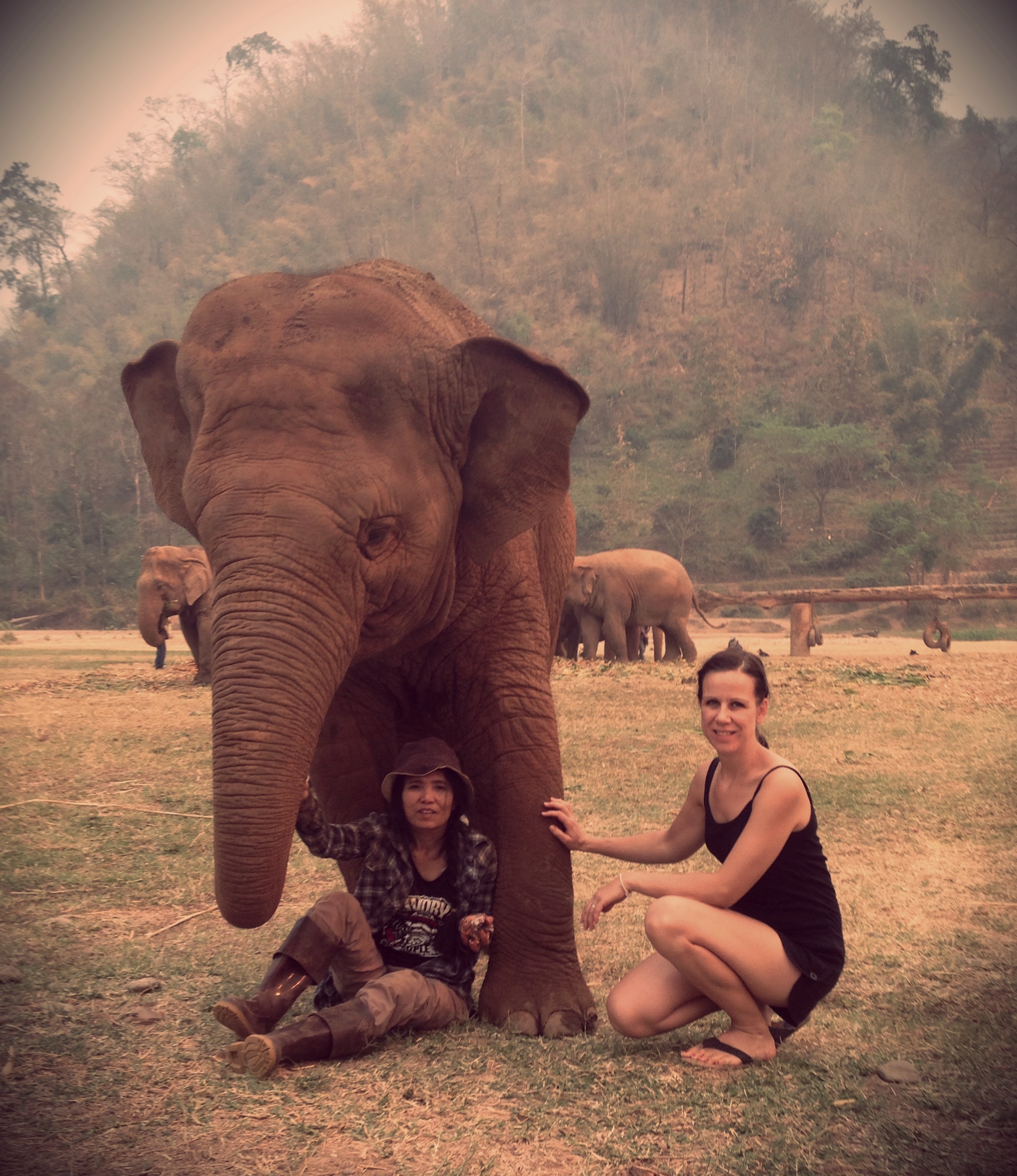
IMG_1789 copySpeaking of brutal, last month an artsACT grant took me to Elephant Nature Park (ENP), an elephant sanctuary in Thailand for rescued elephants, to do research for my next picture book. The trip wasn’t brutal, in fact it was hands down one of the most incredible experiences of my life. But before the elephants arrive at the sanctuary they have experienced a lifetime of brutality. If you want to know more, this article provides a very good summary of why we should never ride an elephant, buy an elephant painting or watch an elephant show. I’m now hard at work on my manuscript and so excited about the potential of getting into schools and talking to kids. I took a gazillion photos of those beautiful elephants (you can see a few over at my Facebook page). This is one of me with the six-year-old elephant Faa Mai and Lek, founder of ENP and one of the most remarkable people I’ve had the good fortunate to meet.

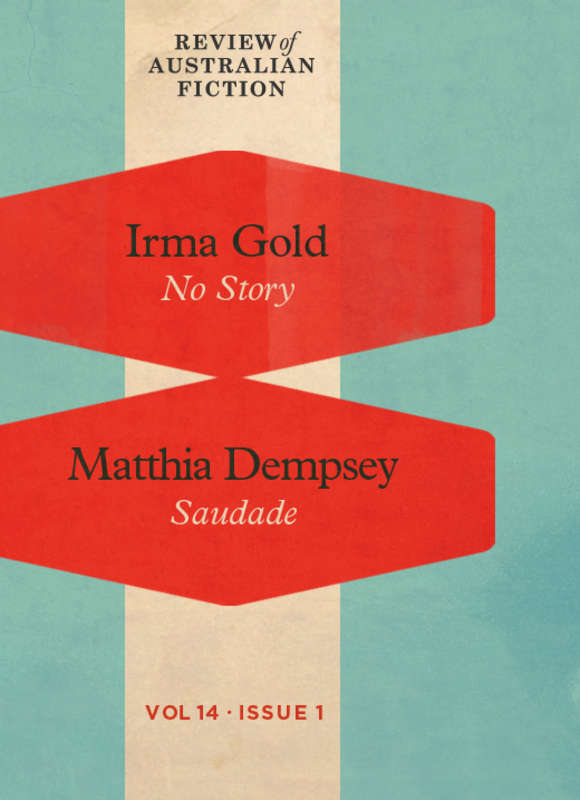
no storyFrom works in progress to the publication of finished works, a new short story of mine, called ‘Bus 864F’, is out in the April issue of Mascara Literary Review (have a read here). And I’ve got another new story in Review of Australian Fiction (RAF), called ‘No Story’ (you can read that one here). It’s worth mentioning a bit more about RAF because they’ve developed a brilliant model. They publish two stories every two weeks from wonderful writers like Christos Tsiolkas, Paddy O’Reilly, Frank Moorhouse, Marion Halligan, Alex Miller, James Bradley and the aforementioned Nigel Featherstone, among many others, so I’m honoured to be in their company. One of things I love about RAF is that they have no word limit. Most journals favour stories that sit around the 3000-word mark, but being commissioned to write a story of any length was freeing, and I’m really pleased with what emerged. The other thing I love is that RAF pairs an established writer with an emerging writer. And the former gets to pick the latter. So it was a real pleasure to be able to select Matthia Dempsey as my RAF partner in crime. I’ve known Matthia since I emigrated to Australia at age nine. Back then we climbed blossom trees together and dreamed of being Anne of Green Gables. We had no idea that we’d both end up as writers and editors. And as you’ll see from her story, ‘Saudade’, Matthia is an extremely fine writer. You can read both our stories for less than the price of a cup of coffee here, or, better yet, since ours is the first in a new volume it’s the perfect time to subscribe.

And finally, to editing. Although I tend to focus on my writing on this site, I’ve just taken on a new role as Editor at Inkerman & Blunt. It’s a new publisher, led by powerhouse Donna Ward, that is producing very handsome and intelligent books. I’m working on lots of exciting projects, so stay tuned.

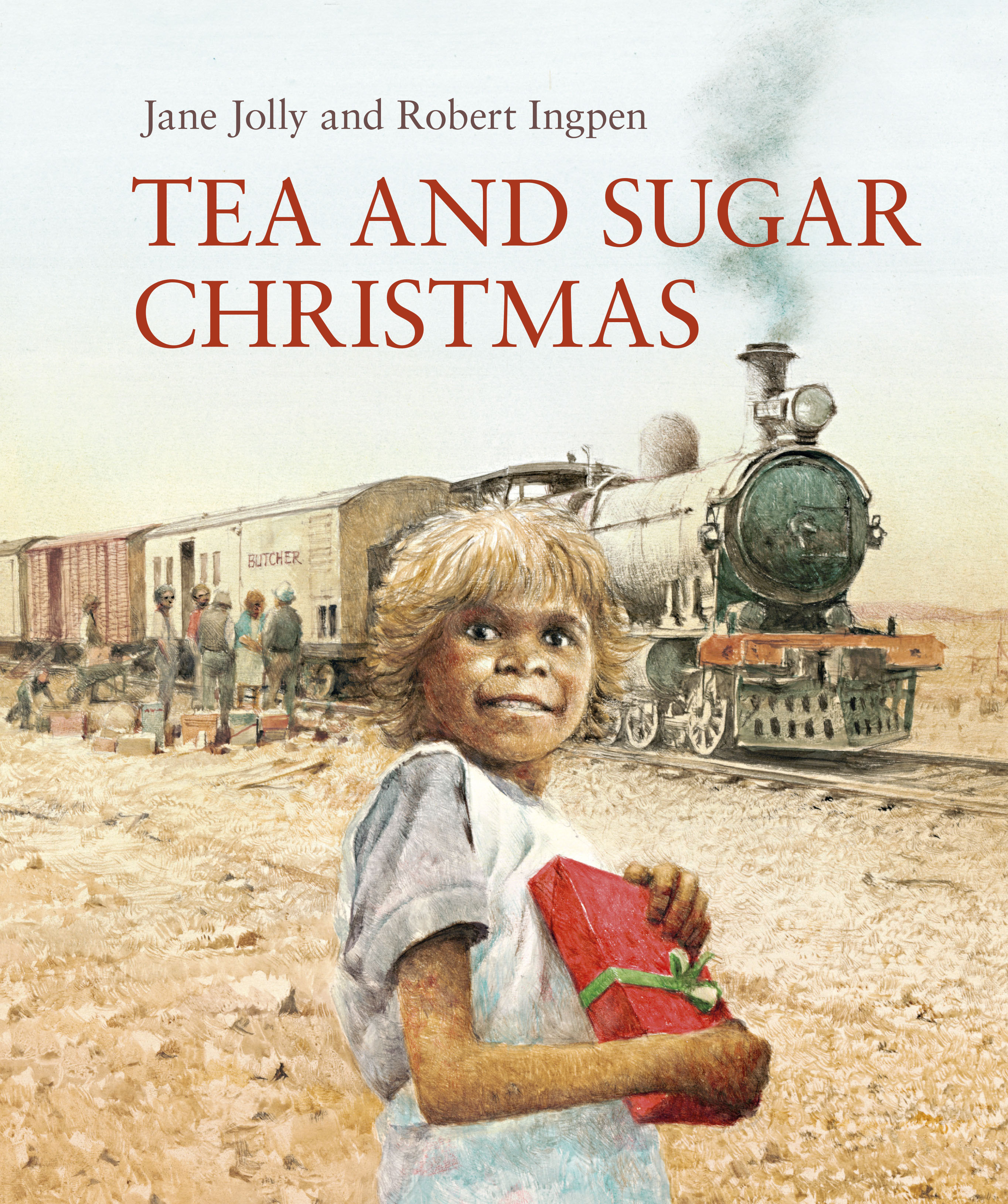
tea-and-sugar-christmasAnd I also want to mention Tea and Sugar Christmasby Jane Jolly and Robert Ingpen, published by the National Library of Australia, which has just been shortlisted for the Australian Book Industry Awards (ABIA). This picture book was such a pleasure to edit, and I’m particularly delighted at the recognition it’s receiving because it is the story of a young Indigenous girl, two categories that make sales and marketing teams nervous. ‘Girls’ because, as we are always told, boys don’t want to read female protagonists. And ‘Indigenous’ because, as you may have noticed, picture books have predominantly Anglo-Saxon characters. We need more publishers willing to take the ‘risk’ of publishing culturally diverse characters, so kudos to the National Library for doing just that. And I’m thrilled that it has paid off, with Tea and Sugar Christmas selling strongly and now receiving an ABIA nod. Fingers crossed it comes out the winner!

Well that’s it from me for now! Keep in touch over at Facebook and Twitter.

MOTHERHOOD AND MAYHEM: CBCA CONFERENCE 2014

  • by

I was thrilled to be invited to talk on a panel of local authors — billed as ‘local treasures’ no less — at the National Conference of the Children’s Book Council of Australia. Motherhood and Mayhem was our topic — with three kids aged three to almost 11 could there be any literary panel more perfectly aligned with my life?

What any of us said on the day is a bit of a blur. There were lots of laughs, I remember that. And it was a joy to share the stage with Tania McCartney (Chair), Stephanie Owen Reeder and Tracey Hawkins. I somehow managed to cleverly position myself in front of the wine (what we all need at the end of the day) and perhaps not so cleverly in front of Tracey’s body parts (she’s an ex-cop and has been known to take inspiration from her former life).

I’ve never seen a panel on this topic before but last year when the four of us started discussing what we might do it seemed like an obvious choice. There are so many women out there trying to balance the need to write with the needs of family. And both are needs. If only the washing did itself, or writing paid enough to hire an in-house chef. One can dream.

Read More »MOTHERHOOD AND MAYHEM: CBCA CONFERENCE 2014

The question we all constantly get asked is, ‘How do you do it?’ I’m still not sure that I have an answer. What I do know is that I never stop. And I’ve got very good at wearing blinkers to shield me from the housework when I have a precious hour or two in which to write.

The response to the panel was wonderful (and to the lady who said that I don’t look old enough to have an 11 year old — bless you a thousand times!). We knew when we were planning our topic that everyone could relate in some way or another to the challenges of multitasking. Lots of the teacher librarians came up to say that the whole juggling act was familiar territory managing classes of children. And then there were the mother/writers who sat in the audience nodding in recognition.

I stumbled across this summary of the conference and love that we get a mention under the heading ‘Cool Canberra author chicks’! Angela Moyle goes on to say, ‘What a revelation!…These awesome ladies…have inspired me to make the time to write, and stop making excuses!’ Well now, that just makes me happy.

TREASURES AT THE CBCA CONFERENCE

  • by

Last weekend at the CBCA Conference was one of the most wonderful experiences I have had yet as a writer. I met old friends and new, had wonderful conversations with intelligent, creative people, ate dinner in the War Memorial under the fighter planes, met so many inspiring teacher librarians passionate about reading, drank lots of bad coffee, was part of the ‘Local Treasures’ panel where we spoke about the crazy juggling act of being both a writer and a mother (more on that in another post), and laughed and laughed and laughed. I’m still trying to process everything that happened and have no idea how to capture it all in just one short post. So I thought that I would pick out some of the featured authors and share a few of my favourite books.

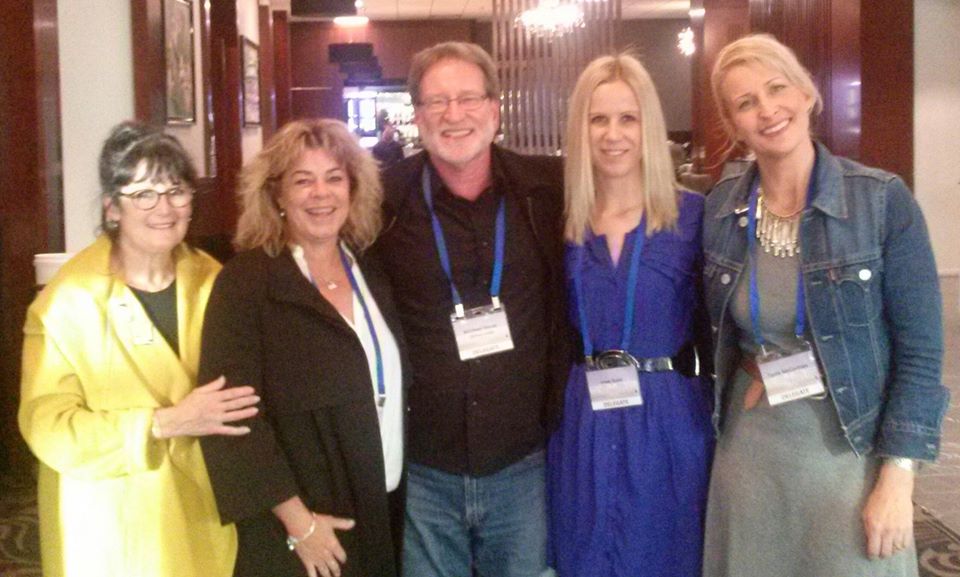
Glenda Millard_Tracey Hawkins_Michael Gerard Bauer_Irma Gold_Tania McCartney
Glenda Millard, Tracey Hawkins, Michael Gerard Bauer, Irma Gold, Tania McCartney

I have to start with Glenda Millard because I was a little star struck meeting her. In person she was beautiful — gently spoken, dressed in bold colours. Two of her picture books in particular have been treasured favourites in our house — Heart of the Tiger, which always makes me want to weep,  and Kaito’s Cloth which was Miss Ten’s favourite book for the longest time and still sits on her bookshelf despite the fact that she says she is far too old for picture books. Kaito’s Cloth was also important to me after I was told by both a publisher and an agent that they couldn’t sell Megumi and the Bear ‘because of its snowy setting’. At the time we were reading Kaito’s Cloth daily; it has snow on every page. If Glenda can do it, I thought, so can I. Thankfully the incomparable Walker Books agreed. I was too shy to tell Glenda how much she has inspired me at the conference, but maybe next time.

Read More »TREASURES AT THE CBCA CONFERENCE

During one plenary session Glenda and Stephen Michael King spoke about their collaborative process. I adore Stephen’s work — seriously ADORE! — and they clearly have a very special relationship. Glenda explained how when she is writing a book and thinking about the illustrations she has ‘no idea what I’m desiring, I just know that they’re Stephen’s’. Their latest picture book, The Duck and the Darklings, is extraordinary — for adults as much as children.

I missed most of Libby Gleeson and Freya Blackwood talking about their process because I was doing post-panel stuff (signing books, etc), but I adore their work, separately and together. I recently went to a workshop with Libby and she handed us all a copy of her first picture book, One Sunday. Master Two has been inseparable from it ever since. Even if we are just driving five minutes to pick up the older kids from school, One Sunday has to come. We almost left it at a café and it just missed being dropped into a puddle. Thankfully it has survived, unscarred, and is read daily.

For Freya my pick is going to be The Terrible Suitcase. All her illustrations are to-die-for but this is Emma Allen’s (incredible) debut book and I met Emma for the first time this weekend, having no idea that she was a local girl. Like me she has young children and is juggling lots of balls. I can’t wait to see what she creates next.

Julie Vivas spoke candidly about developing her illustrations and about how she is ‘always disappointed in herself’ when she finishes a book because she can see where she could have done better.  Freya Blackwood related, revealing that she thinks some of her books are terrible and she’s glad people haven’t noticed. I can’t imagine which books Freya could possibly consider terrible, but I understand the mindset, as I’m sure all creative people do. Freya believes she has only created one perfect book, Amy and Louis (with Libby Gleeson). Vivas named Possum Magic as her most successful achievement.

bob graham ex2
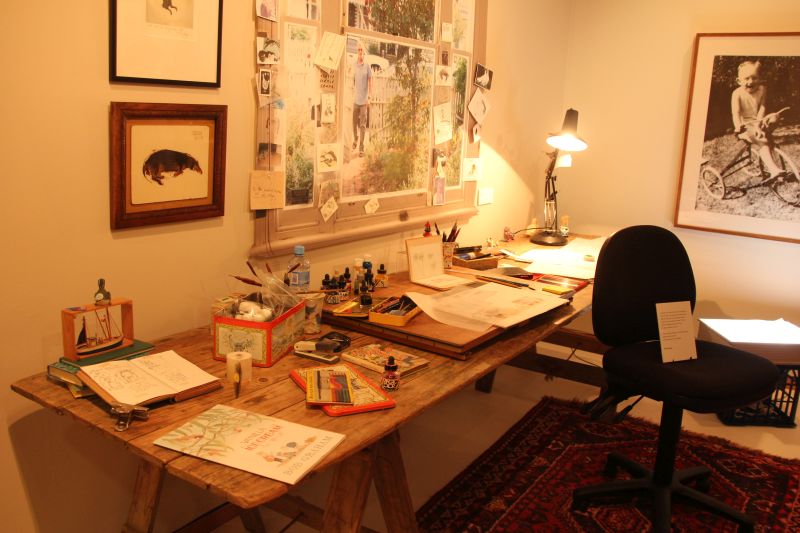
Bob Graham’s desk, recreated at CMaG

I’m not going to pick one Bob Graham book (a seriously impossible task) but instead encourage you to go to a mind-blowing retrospective of his work at CMaG. The conference crew went along to opening night and I’m going to go again with my kids. The exhibition is on until August and I would encourage you all to visit. I particularly loved the recreation of Bob’s working space, complete with paints, pencils and post-it notes.

Illustrator of over 100 books, Robert Ingpen was scheduled to appear at the conference but sadly had to cancel. Nevertheless his latest with author Jane Jolly, Tea and Sugar Christmas, was launched there. It is such an evocative book that I had the good fortune to edit. The story is woven around the train that serviced settlements along the Nullarbor Plain during the 1900s, and has a young Indigenous girl, Kathleen, as the main protagonist — such a rarity. Jane got a shock when she first saw Robert’s illustrations. Without knowing it, he had drawn a girl who looked exactly like a student Jane once taught. The launch itself held another surprise when author Phil Cummings — a long-time friend of Jane’s — announced that his brother used to drive the Tea and Sugar train and one of his mates handed out the tea and sugar. Phil had never previously thought to mention this to Jane!

In a funny way Kathleen leads me to Nadia Wheatley’s My Place, which at the time of its release was seen as a radical book. It is now a school staple, but during the 1988 bicentennial—when we were celebrating an invasion — Nadia’s book was seen to be unAustralian. The depiction of migrants and Indigenous people in picture books was controversial.

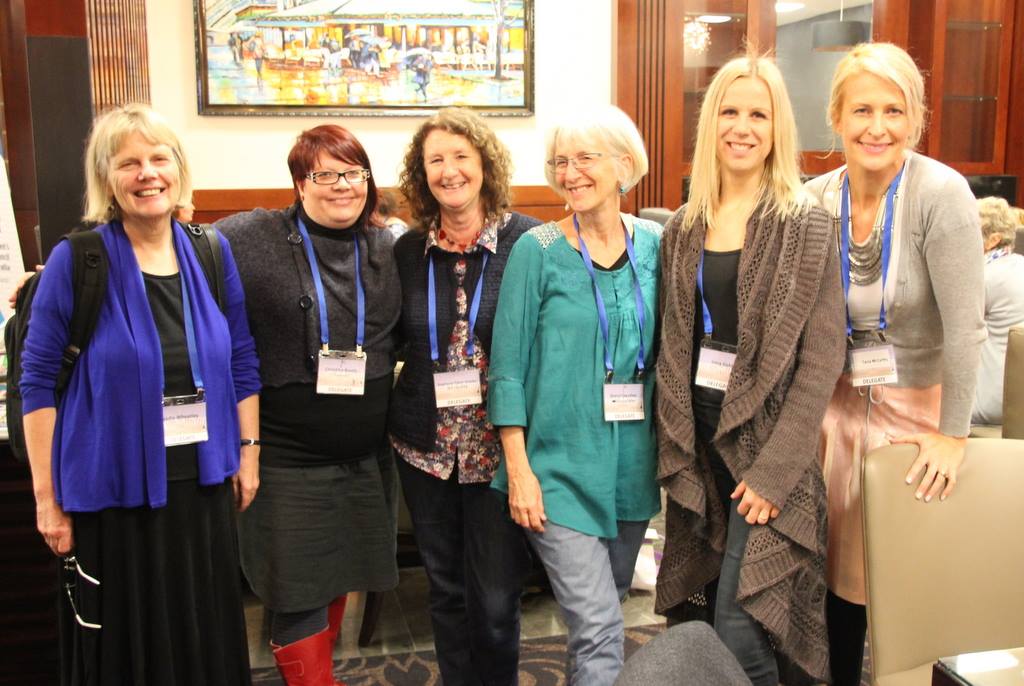
Nadia Wheatley Christina Booth Stephanie Owen Reeder Sheryl Gwyther Irma Gold Tania McCartney
Nadia Wheatley, Christina Booth, Stephanie Owen Reeder, Sheryl Gwyther, Irma Gold, Tania McCartney

In fact, My Place won one award under a category for ‘migrants, Aborigines and girls’ which was designed to encourage the publication of these neglected subjects. On hearing this news the audience collectively gasped, and yet the reality is that these three categories are still underrepresented, even that of girls because the accepted view is that boys won’t read books about girls. We still have a long way to go.

Michael Gerard Bauer is beloved by Master Seven. When he found out that I had met Michael he immediately sat down and wrote him a card (complete with illustrations). I was given strict instructions to deliver it the following day. Michael subsequently wrote Master Seven some lovely messages on one of his Eric Vale books and a laminated cover proof of the next yet-to-be-released Secret Agent Derek ‘Danger’ Dale book. Needless to say Master Seven was beside himself. He spent the evening copying the cover and then, in the absence of Michael’s story, wrote his own!

Another of Master Seven’s idols, Andy Griffiths presented on humour in children’s books and how adults often don’t ‘get’ the things kids find funny. By way of example he mentioned Barky the Barking Dog from the treehouse books. All three of my kids think Barky is utterly hilarious and having just been to the 13 Storey Treehouse at the Playhouse, that very night they were telling my parents all about Barky. As if to prove Andy’s point, my dad was utterly baffled: ‘Why is this funny?’ and yet my three kids (aged three to ten) kept dissolving into fits of giggles trying to explain what Barky does (barks at things, of course). The treehouse series has captivated kids everywhere, and we are counting down until 52 Storey comes out.

I’m going to finish with one of my favourite people who I finally got to meet, Choechoe Brereton. Choe was one of 22 authors in an anthology of miscarriage stories that I edited, The Sound of Silence (2011). We’ve been emailing ever since and her debut picture book, A House for Donfinkle (coincidentally published by Walker Books, so we are now publishing house buddies) was launched at the conference. Choe is a gorgeous person and this is a gorgeous book illustrated by Wayne Harris. Do yourself a favour and check it out.

I haven’t even mentioned Jackie French, Morris Gleitzman, Barry Jonsberg,  Brownyn Bancroft, Belinda Murrell, Sally Murphy or my panel posse (Tania McCartney, Tracey Hawkins and Stephanie Owen Reader) to name just a few of our most glittering treasures, but here I must end (for now — ramblings on our Motherhood and Mayhem session to come). In short, it was a glorious weekend and massive congratulations must go to the team who pulled together such an inspiring event.

ADELAIDE WRITERS’ WEEK, PART 1

  • by

I have always considered Adelaide Writers’ Week to be the Mecca of Australian literary festivals, and last week I made the pilgrimage for the first time. It didn’t disappoint.

Set in the Pioneer Women’s Memorial Gardens under marquees and shade sails, the outdoor setting lends the event a relaxed, convivial feel. Combined with perfect summer weather (I’m told previous years have seen temps in the forties but this year we were blessed with 32 degrees tops) and a stellar line-up of writers, I was in seventh heaven all week-long.

The sessions I found most invigorating were the panels (as opposed to those where an individual author was interviewed about their recent release). By their very nature the panels allowed for a broader discussion of writing, publishing and converging thematic concerns.

I particularly enjoyed Hannah Kent and Elizabeth Gilbert in conversation with Kalinda Ashton. This proved to be an interesting discussion about turning history into fiction. Gilbert talked about the four years of research for The Signature of All Things, saying, ‘You know 20 times more than you reveal.’ She kept boxes and boxes of index cards but said she then needed ‘to have the confidence to forget’. And I loved this analogy: ‘Because I’d prepared so much it was like riding a bike downhill.’

Read More »ADELAIDE WRITERS’ WEEK, PART 1

Kent spoke about knowing when to stop researching and get on with the business of writing: ‘When I realised I didn’t need to refer to my notes I was at the point of saturation…That’s when I knew I had granted myself the license to write fiction.’ Kent’s Burial Rites is a book that warrants the clichéd but entirely true ‘unputdownable’ endorsement, and Gilbert’s The Signature of All Things is now on my ever expanding To Read List.

Kalinda Ashton, Fiona McFarlane & Louise Doughty

I am always fascinated by other writers’ processes and Louise Doughty (who was generally marvellous) spoke most candidly about hers. Doughty explained that she doesn’t write sequentially. Every morning she gets up and writes whatever scene comes to her. ‘It gets to the point that I have a mass of mess,’ she said. ‘It looks not so much like a novel that’s being written, but a novel that’s being regurgitated. At that point I panic…and go and have a little cry.’ However, Doughty explained that she quickly gets over herself and begins spreading everything she’s written across the floor. She plots out what happens sequentially and then puts scenes in order. Once the paper trail is complete, she cuts and pastes on her computer accordingly. Doughty recounted how she arrived at Adelaide airport with her latest novel in her handbag. She had already ordered the sheaf of papers but not made the corresponding changes on her computer. Consequently she was clinging onto her handbag!

I also liked the idea of Fiona McFarlane’s document with its clever title, ‘The Moves’ (interviewer Kalinda Ashton — incidentally, an author whose work I also love — said she might have to appropriate this title, and I may too!). ‘The Moves’ was written entirely in red pen (‘to frighten myself,’ McFarlane said) and outlined every plot point. McFarlane used this document to work through ‘many, many drafts to get it [her novel, The Night Guest] right’.

Incidentally, the session with Doughty and McFarlane was a cracker, delving into issues of trust, both within their novels and the reading process itself. Doughty expounded on the idea that we all experience a novel differently, according to our experiences in life and where we are at that particular moment in time. ‘Novels are mirrors in which we see ourselves reflected,’ she said.  Doughty illustrated this point by talking about a male friend’s reaction to Apple Tree Yard. He said that for him the book reinforced that ‘it’s possible to love two people at the same time’. As the only person to take this ‘message’ away from her book, Doughty thought, ‘Should I take him out for a drink and find out what’s going on in his life?’ We take from a novel what suits our narrative about our own lives.

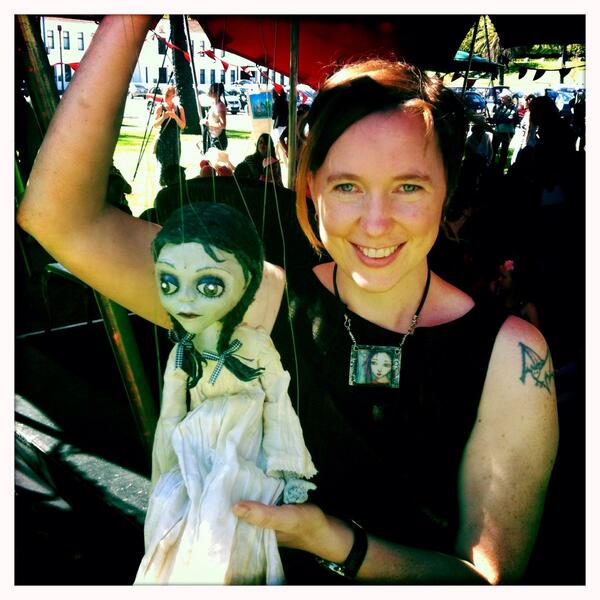
Asphyxia with Martha from The Grimstones

Let’s end this post with a bit of fun (I can’t cram everything in here, so Part 2 and 3 will be along shortly). Hanging out in the tinsel-covered kids’ tent was a blast. Sadly, my children were back in Canberra but I joined the merry chaos regardless. Mem Fox is an absolute pro and immediately got the audience laughing. I thoroughly enjoyed watching her in action (kissing the illustrator’s name on every book she read).

Seeing Andy Griffiths talk I wished Master Seven could have been there. He would have been starry-eyed. And it was really something to see the tent overflowing with boys all there to talk books. Many boys are reluctant readers, but Griffiths makes all the right moves to get them hooked. There was lots of laughter and lots of ‘gross’ stories. My favourite moment: when Griffiths revealed that Jill from theTreehouse books is his wife in real life. A noise along the lines of ‘ewwwww’ rolled through the tent. Apparently this was categorised as ‘gross’ humour!

I also got to meet one of my childrens’ favourite authors, Asphyxia. They have exchanged letters and emails, and Master Seven long ago converted our cubby house into a Grimstones-inspired apothecary. He is still in there most days mixing up new potions, a very real example of the way books can fire the imagination.

Writers’ Week, Part 2 will delve into darker territory, namely the commercial side of the industry and how it is shaping publishing lists.